

From Our Correspondent
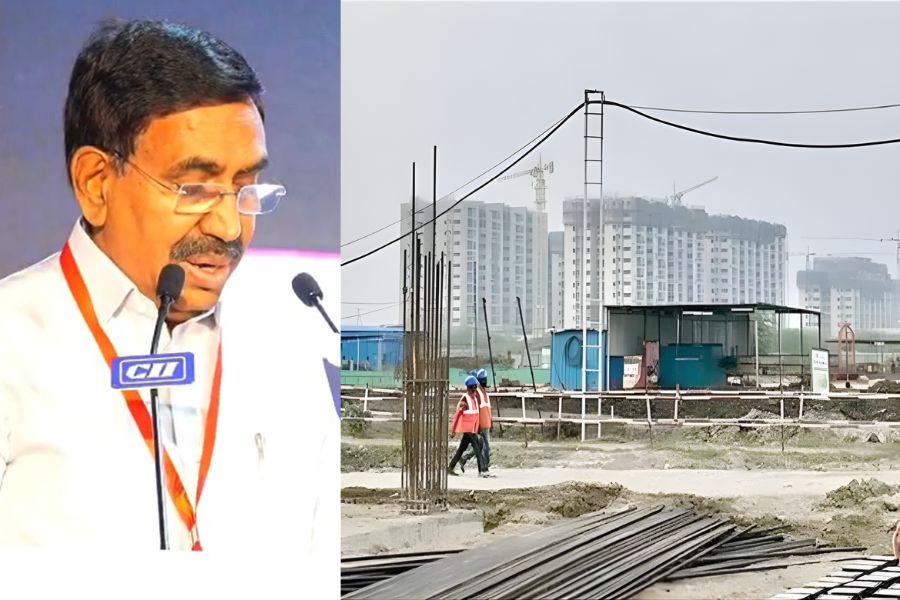
Visakhapatnam: The Andhra Pradesh government laid out a comprehensive roadmap for Amaravati, positioning it as India’s most advanced and sustainable Greenfield capital. Addressing the CII Partnership Summit 2025, the Municipal and Urban Development Minister P Narayaba presented a detailed vision of how the capital is being shaped through people’s participation, global planning standards, and long-term sustainability principles.
People-Built Capital with Global Planning
Amaravati, spread across 217 sq. km, is described as the country’s largest co-created capital city. More than 29,000 farmers voluntarily contributed land under India’s biggest consensual Land Pooling Scheme, giving the project a unique citizen-driven foundation. The Minister said the city is being developed as an inclusive, economically vibrant, and environmentally responsible capital for future generations.
At the centre of the broader 8,350 sq. km APCRDA region, Amaravati is projected to reach a population of 3.5 million, a USD 35 billion economy, and 1.5 million jobs by 2050. The Master Plan, prepared with support from the Government of Singapore, sets global benchmarks for phased and high-quality development.
Connectivity Infrastructure Gets Major Push
Connectivity remains a core pillar of Amaravati’s design. The capital region is intersected by nine National Highways, with NH-16, NH-65, and NH-13 passing through the city. The government has sanctioned a 90 km Inner Ring Road and a 190 km Outer Ring Road to strengthen regional mobility.
Rail connectivity will be boosted with the Hyderabad–Namburu line running adjacent to the capital and high-speed rail proposals linking Amaravati to Hyderabad and Chennai, cutting travel time to the Telangana capital to about two hours. The capital is 25 km from Gannavaram Airport, while a 5,000-acre Greenfield International Airport is proposed. The upcoming Machilipatnam Port, 95 km away, is expected to enhance Amaravati’s maritime access.
Sustainability Framework Anchors City Design
The Minister emphasised that Amaravati is being built around a strong environmental, social, and economic sustainability framework.
Environmental Features:
More than 30% of the city is reserved for blue–green infrastructure, including ecological corridors, parks, seven islands, a 48.3 km canal network, and a 21 km Krishna riverfront. A planned 3,300 km network of cycling and walking tracks aims to reduce dependency on motorised transport.
Social Infrastructure:
Amaravati is designed on the 5–10–15 urban livability model, ensuring residents are within five minutes of emergency services, 10 minutes of recreation, and 15 minutes of workplaces and key public amenities.
Economic Strength:
A grid-based road network with 360 km of trunk roads and 1,500 km of internal roads, along with integrated underground utilities for ICT, water, power, and drainage, is expected to support sustained economic activity.
Infrastructure Progress and Investments
The government has planned ₹91,000 crore worth of infrastructure works in the capital, of which projects totalling ₹51,000 crore have been awarded and are targeted for completion within three years. These include trunk roads, flood mitigation systems, public buildings, and neighbourhood infrastructure.
Amaravati has already attracted over ₹25,000 crore in committed investments across education, healthcare, hospitality, research, and financial services. Institutions such as VIT-AP, AIIMS, BITS Pilani, LV Prasad Eye Institute, Hilton, Marriott, SBI, NABARD, and Quantum Valley are among the key players establishing a presence in the capital region. The ongoing investment summit has brought in an additional ₹40,000 crore.
Model for Future Indian Cities
Calling Amaravati a blueprint for sustainable and people-centric urban growth, the Minister said the capital aims to set a national benchmark for future Indian cities. “We are not just constructing a capital,” he said. “We are creating a long-term urban legacy built on participation, resilience, and global standards.”
With its blend of citizen involvement, sustainable design, and large-scale infrastructure, Amaravati is being projected as a transformative capital city for the decades ahead.