

By Ramesh Kandula
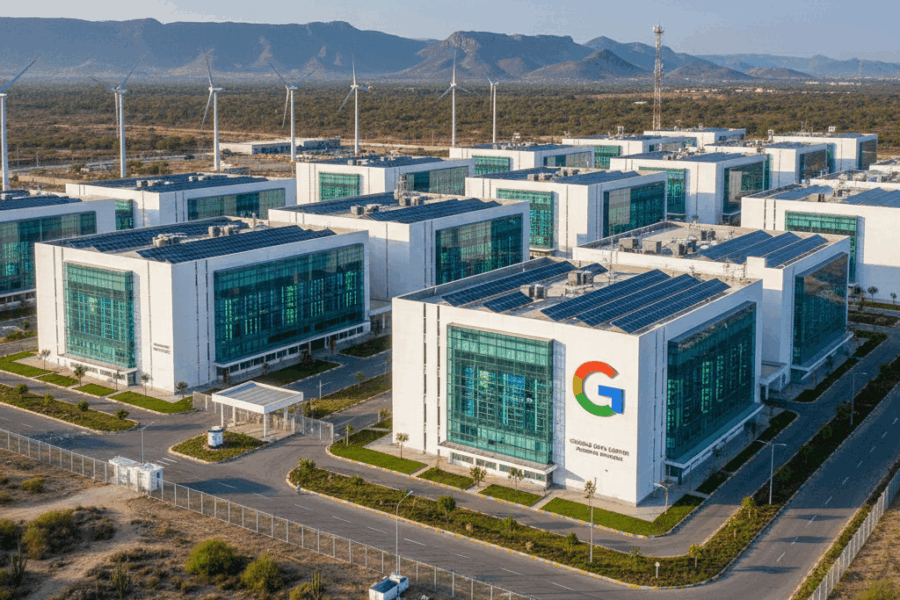
The political tone around Andhra Pradesh’s biggest foreign direct investment — the ₹1.33 lakh crore Google Data Centre coming up in Visakhapatnam — has undergone a curious transformation. What began as a campaign of dismissal and criticism by the YSR Congress Party has now turned into a belated endorsement by its leader, Y.S. Jagan Mohan Reddy.
When the project was first announced under Chief Minister N. Chandrababu Naidu’s government, the YSRCP and its social media ecosystem were quick to question both its viability and relevance. Party leaders scoffed at the idea of a 1 GW data centre, calling it a “PR gimmick.” Some even claimed that such facilities would bring no real employment and were environmentally unsustainable — citing the huge amounts of power and water required for cooling data servers.
At the time, Jagan’s camp tried to contrast what it described as “Naidu’s hype” with what it claimed were the YSRCP government’s “realistic” welfare priorities. The criticism fit the familiar narrative that TDP’s development agenda favoured “big business,” while YSRCP was focused on “people-centric governance.” But this argument has collapsed under the weight of Jagan’s own recent statements.
Speaking at a public meeting in Visakhapatnam, the former Chief Minister suddenly changed tack. He said he “welcomed” the Google Data Centre project, calling it “the need of the hour in the age of Artificial Intelligence.” That remark itself might have been seen as a mature course correction — had he stopped there. But Jagan went further, claiming credit for bringing the project to Vizag. He said the facility was “an extension of the Adani Data Centre” that his government had cleared during his tenure.
That statement, however, doesn’t hold up to scrutiny. The Adani Data Centre proposal dates back to the Naidu administration’s previous term. The foundation stone was laid in 2018 with the intent of building a large data park in the same region. When the YSRCP came to power in 2019, the project ran into uncertainty. Reports from that period suggest that the Jagan government paused or delayed the Adani project, citing the need for “more clarity” on environmental and operational aspects. A second foundation ceremony was later held under Jagan’s watch, but little movement followed on the ground.
The irony is striking. The same leadership that had stalled the earlier Adani project now claims ownership of the Google Data Centre — even though the latter emerged from a fresh set of discussions between Google, Adani Connex, and the present state administration. Chandrababu Naidu’s government revived the investor dialogue and secured the commitment that has now placed Visakhapatnam on the global data map.
Why did Jagan change his stance? The reasons could be tactical rather than ideological. One possibility is that Adani Connex — a joint venture of Adani Enterprises and EdgeConnex — is the infrastructure partner for the Google facility. Given Jagan’s political proximity to the Adani Group during his tenure, it would have been awkward for him to attack a project in which Adani is involved.
Another likely factor is the national optics. The Central government has made digital infrastructure and AI-based innovation key pillars of its economic agenda. Openly opposing a massive Google investment could have sent a wrong signal to investors and policymakers in Delhi. In the post-2024 political landscape, Jagan can ill afford to be seen as obstructionist or anti-industry — particularly at a time when his political capital is diminished and the TDP-led coalition has returned to power in both Andhra Pradesh and at the Centre.
In fairness, it is a good sign that Jagan has stopped opposing the project. His new tone suggests a grudging recognition that Andhra Pradesh stands to gain from investments in AI, data processing, and digital services, even if the immediate job numbers are modest. Data centres bring secondary benefits — from ancillary construction activity to enhanced digital infrastructure and potential downstream industries.
What is unbecoming, however, is the attempt to rewrite history. Taking credit for a project that clearly originated under another government does not elevate a political leader’s stature. On the contrary, it reinforces the perception that Jagan’s political communication often oscillates between confrontation and opportunism.
The Google Data Centre is more than just a corporate investment — it represents Andhra Pradesh’s re-entry into the high-technology map after years of drift. Whether one calls it symbolism or substance, its presence in Visakhapatnam sends a message that the state is again open for big ideas and global partnerships.
For now, the more important outcome is political peace around the project. That the YSRCP is no longer attacking the data centre or casting doubts on its environmental and economic logic is a welcome development. Andhra Pradesh’s future depends on continuity in policy and stability in governance — not on which party claims the credit.
If Jagan Mohan Reddy’s shift signals that recognition, even belatedly, then it’s a positive turn. The Google Data Centre doesn’t need partisan ownership; it needs political consensus — and, for once, Andhra Pradesh might just be heading in that direction.