

From Our Correspondent
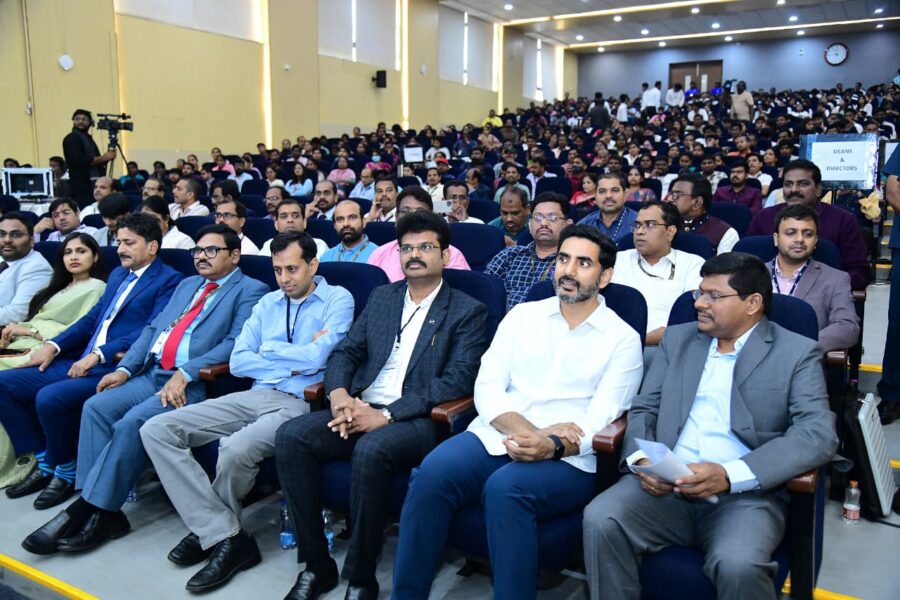
Amaravati: Andhra Pradesh IT, Electronics, and Education Minister Nara Lokesh has called for sweeping reforms in higher education to align with Prime Minister Narendra Modi’s vision of transforming India into a $30 trillion economy. Speaking at the CII–VIT Andhra Pradesh Higher Education Conclave 2025 in Amaravati, Lokesh said education must shift focus from degrees to skills to meet the demands of a fast-changing economy.
“India is already on the verge of becoming a $5 trillion economy. The question now is how we reach $30 trillion,” Lokesh said. “Human capital and intellectual strength will be the strategic pillars of this growth, and higher education must evolve accordingly.”
Lokesh said Andhra Pradesh is moving towards becoming a global manufacturing and innovation hub, driven by what he calls the “Speed of Doing Business” model. “In the last 17 months, we attracted $120 billion in investments. Another $120 billion is expected at the upcoming Global Investors Summit. By 2029, our goal is to secure $1 trillion in cumulative investments,” he said.
Highlighting India’s youth potential, Lokesh noted that 54% of the population is below 25 years of age, calling it a “demographic dividend” that can only yield results through employable education. He cited data showing that only 34.7% of India’s working-age population has formal skill training, compared with 96% in South Korea and 80% in Japan.
To bridge the skill gap, Lokesh said Andhra Pradesh launched the Skill Census, profiling every citizen’s competencies and identifying training needs. “We started this initiative from my own constituency, Mangalagiri. It will help tailor workforce development to industry needs,” he said. The state has also developed an AI-driven ‘NaiPunya Portal’, which will link skilled youth with employment opportunities.
Lokesh outlined a five-pillar strategy to transform the higher education landscape:
-
Curriculum to Career – Aligning syllabi with industry needs to ensure job readiness.
-
Research and Innovation – Setting up centres of excellence, incubators, and patent cells in universities.
-
Digital Future Skills – Expanding courses in AI, quantum computing, semiconductors, green tech, and robotics.
-
Internationalisation – Partnering with global universities for joint degrees and research collaborations.
-
Regional Balance – Promoting cluster-based industrial growth to ensure equitable development.
Andhra Pradesh, Lokesh said, is now positioned for “next-generation jobs and startups” with leading institutions like IIT-Tirupati, IIM-Visakhapatnam, IIITs, and VIT-AP acting as knowledge anchors.
“We are marching ahead with Vision 2047 — Swarna Andhra — to make Andhra Pradesh a $2.4 trillion economy by the time India reaches its centenary of independence,” Lokesh said.
CII Southern Region Chairman Ashwin Mahalingam, VIT Vice-President Dr. G.V. Selvam, and other industry and academic leaders participated in the conclave.