

Ramesh Kandula
The inaugural Ramoji Rao Excellence Awards were announced on the occasion of media titan Ramoji Rao’s birth anniversary, drawing an unusually high-profile gathering that underlined the regard he continues to command across political and social spheres. The Vice-President of India, the Governor of Telangana and the Chief Ministers of both Telugu states attended — a rare convergence that reflected the stature Ramoji built over six decades in media, cinema, and entrepreneurship.
The awards were instituted in seven categories covering public service, literature, arts, innovation, journalism, and grassroots leadership.
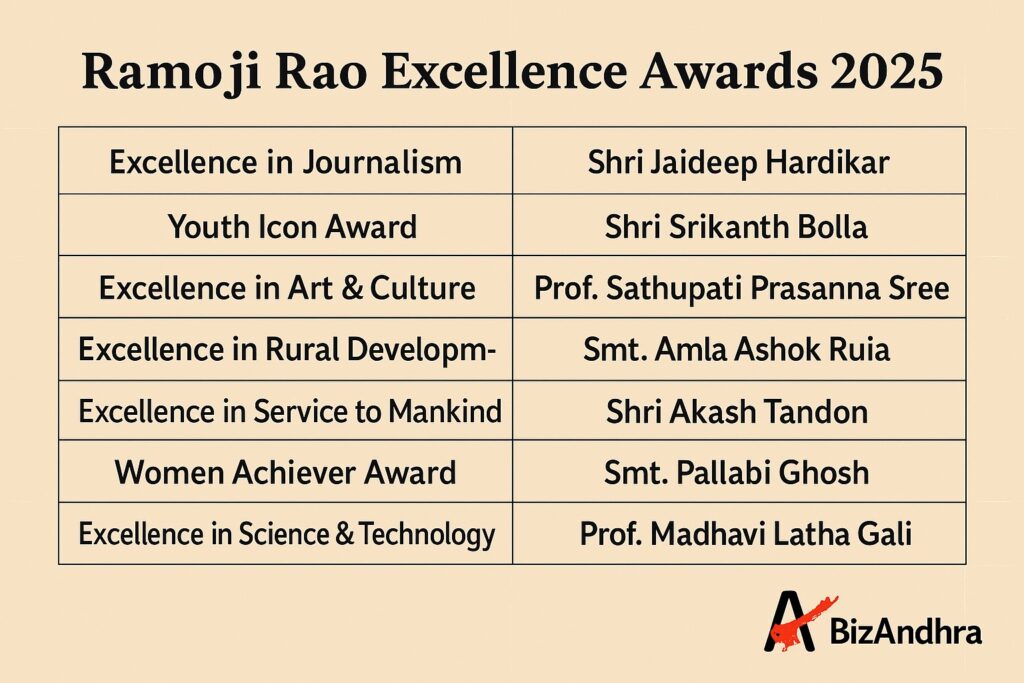
What stood out immediately was that none of the awardees are household names, nor have they been prominently featured in mainstream media. This was deliberate. Staying true to Eenadu’s long-standing philosophy of celebrating substance over spectacle, the selection committee chose individuals known for quiet excellence rather than visibility or influence. In an era where many award platforms cherry-pick headline-makers to boost their own relevance, the Ramoji Awards took the opposite route — spotlighting people who have worked with integrity and dedication, away from publicity and patronage. It is a choice Ramoji Rao himself would likely have endorsed without hesitation.
Neither Eenadu nor Ramoji Rao is beyond criticism, and both have faced legitimate scrutiny for their activist role at times. But in a world of relativity, Ramoji stands far above his peers in the business of journalism — a reality that helps explain why leaders across party lines showed up to honour his legacy.
Both Telugu chief ministers underlined this ethos in their speeches. Andhra Pradesh Chief Minister N. Chandrababu Naidu recalled that Ramoji Rao never asked governments for favours — not for his newspaper, not for Eenadu Television, and not even for large ventures like Ramoji Film City. Successive governments, Naidu said, would have willingly obliged had he asked, but Ramoji kept a rigid personal rule: no lobbying, no pressure, and no expectation of favourable coverage. This principle set the Eenadu Group apart in a media landscape where business interests and political influence often overlap. Unlike other media houses, including Andhra Jyothy and Sakshi, Eenadu maintained a consistent distance from the corridors of power, even when it came at a cost.
Telangana Chief Minister A. Revanth Reddy echoed this sentiment with a pointed remark: “There is no need to do favours to the Ramoji Group; it is enough if people in power do not stand in their way.” His line carried an unmistakable subtext — a reference to the pressure and harassment Ramoji Rao faced in his final years, when the Y.S. Jagan Mohan Reddy government attempted to weaponize state machinery against him and the Eenadu Group. It was an episode that tested Ramoji’s resolve, but also reinforced the perception of him as a media proprietor who refused to bend.
The awards, therefore, were more than a tribute. They were a reaffirmation of the values Ramoji Rao stood for: independence, merit, and a belief that real achievers often work far from the spotlight. In recognising such individuals, the inaugural edition set the tone for what could become one of the most credible honours in the Telugu states — an award that reflects not the noise of the moment but the quiet force of genuine contribution.