

By Ramesh Kandula
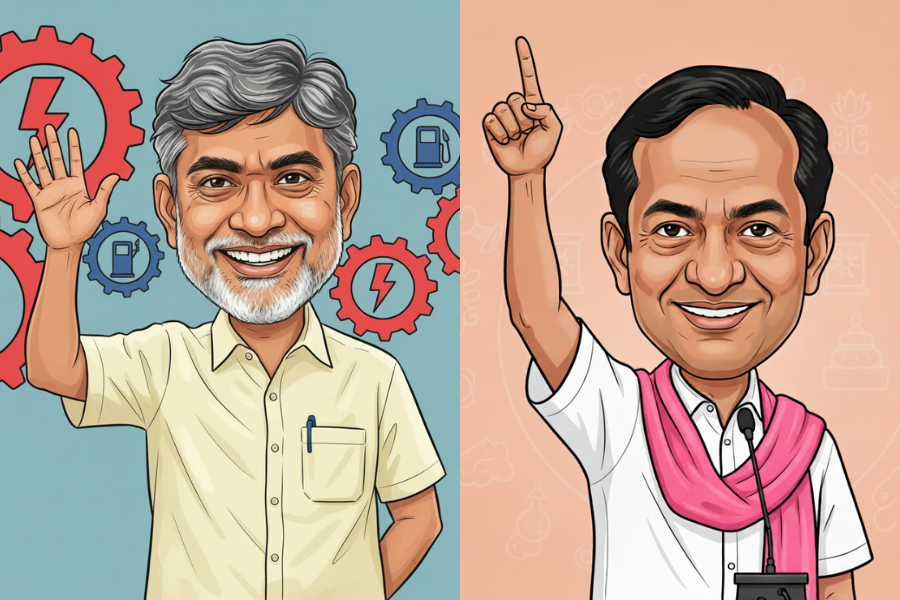
In a press conference on Sunday, Telangana Chief Minister K. Chandrashekar Rao (KCR) derided the investment record of the Chandrababu Naidu government in Andhra Pradesh, alleging that MoUs signed between 2014 and 2019 were mostly hype and that actual investments realised were “not even ₹10,000 crore.” His remarks, delivered with confidence and a mocking tone, are factually incorrect and politically motivated.
Independent reporting and official data show that actual realised investments from that period were far greater, and several marquee projects are operating today.
Actual Realised Investments: Beyond the Headlines
During the 2014–19 period under Naidu’s leadership, Andhra Pradesh signed MoUs worth an aggregate ₹12.32 lakh crore with investors on paper. While not all MoUs immediately translated into on-ground projects by 2019, a significant portion did materialise:
-
According to industry reporting at the time, 309 of those projects went into production with actual investments totalling approximately ₹1.39 lakh crore — not ₹10,000 crore — by the end of 2019.
This figure includes major investments that led to real infrastructure, factories and productive assets — not just signed documents.
Kia Motors: The Most Visible Proof
The best-known example is Kia Motors’ ₹15,000-crore automobile manufacturing plant at Penukonda in Anantapur district. Signed in 2017 and executed rapidly, Kia began production in July 2019 and remains a major employer and export contributor. Its successful commissioning directly rebuts the notion that Naidu-era deals were purely speculative.
Other Realised Investment Stories
Beyond Kia, several projects initiated before 2019 became operational or substantially executed:
-
Andhra Pradesh MedTech Zone (AMTZ), Visakhapatnam: A large-scale medical devices manufacturing park hosting multiple operational units.
-
Kurnool Ultra Mega Solar Park: A 1,000 MW renewable energy park commissioned in 2022 with investments from developers and government agencies.
-
Millennium IT Towers, Visakhapatnam: Functioning IT infrastructure supporting technology companies.
-
Brandix Apparel City Expansion: Significant expansion with tens of thousands of jobs in the apparel sector.
These projects are tangible and operational assets, not unfulfilled promises.
Long-Gestation and Partially Realised Projects
Some MoUs from 2014–19 were longer-term in nature and continued development after 2019 — port projects like Machilipatnam, renewable energy facilities, technology parks and strategic infrastructure. While slower to move, several of these remain in progress rather than cancelled.
Investment Slowdown During 2019–24
Ironically, the biggest slowdown in investments occurred during the Y.S. Jagan Mohan Reddy regime (2019–24) — often seen as politically aligned with KCR. Independent analysis shows that Andhra Pradesh drew just $1.27 billion (~₹10,000 crore) in foreign direct investment (FDI) from October 2019 to mid-2025, a comparatively weak performance among Indian states.
Industry and investor confidence waned during that period due to policy uncertainty and lack of continuity, slowing momentum on earlier commitments.
Post-2024: Renewed Investment Momentum
Since Chandrababu Naidu’s return as Chief Minister in 2024, Andhra Pradesh has seen a resurgence in investment interest. At the 2025 CII Partnership Summit in Visakhapatnam, the state signed over ₹11 lakh crore worth of new MoUs with multinational companies across sectors, and additional large industrial and renewable energy commitments have been announced.
Ministers also highlight that in the first year of the current government, the state attracted around ₹9.4 lakh crore in investor commitments as confidence returned after the previous period of subdued interest.
Conclusion
KCR’s sweeping dismissal of Andhra Pradesh’s investment record under Chandrababu Naidu — claiming realised investments were below ₹10,000 crore — is not backed by the facts. With around ₹1.39 lakh crore actually invested by 2019 and a pipeline of operational and burgeoning projects, the record reflects significant realisation beyond mere MoUs.
Furthermore, investment slowed rather than surged during the 2019–24 regime, and has gained new traction since 2024. The narrative of “hype” does not align with ground reality, and claims based on selective figures should be treated with skepticism rather than taken at face value.