

BizAndhra Desk
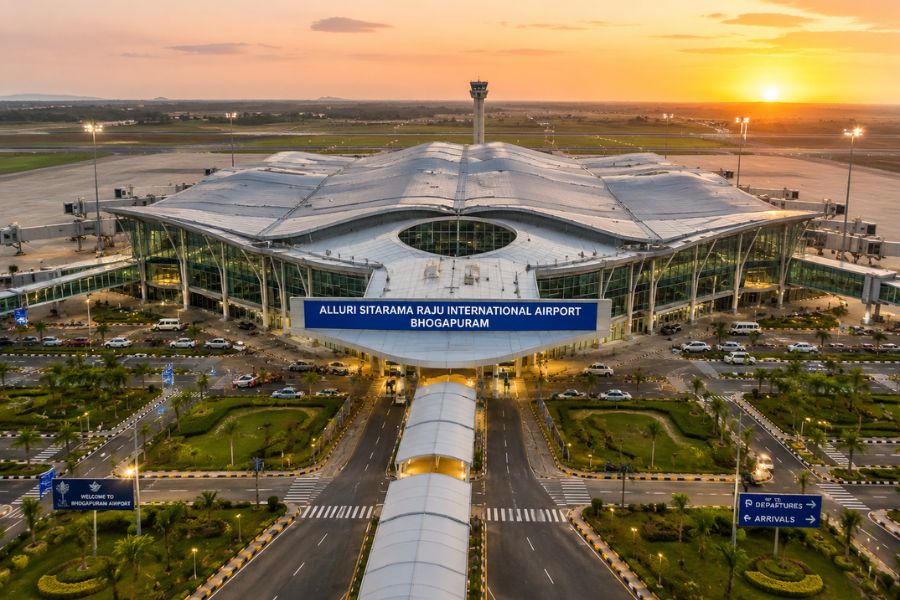
Viskahapatnam region is all set to fly high. Commercial passenger operations from the newly built Alluri Sitarama Raju International Airport at Bhogapuram will commence on July 8, 2026, marking the complete transition of air services from Visakhapatnam.
Prime Minister Narendra Modi is expected to inaugurate the greenfield airport, developed by GMR Visakhapatnam International Airport Limited (GVIAL) at an estimated cost of ₹4,725 crore, in the first week of July.
With the shift, commercial flight operations at the existing Visakhapatnam International Airport will permanently cease on July 8, bringing an end to its decades-long role as the city’s primary airport.
How Services Will Improve After the Shift
The transition to Bhogapuram breaks long-standing constraints faced by the old civil enclave, introducing immediate upgrades to regional aviation:
Unrestricted 24/7 Operations: Free from the military training schedules that restricted civilian slots at the Navy-owned INS Dega airbase, airlines can now operate around the clock, allowing for late-night flights and efficient overnight parking.
Global and Wide-Body Readiness: The airport’s 3.8-kilometer runway is engineered to handle large, wide-body aircraft, making direct long-haul international flights to major global destinations possible for the first time in North Andhra.
Massive Passenger Expansion: The new Terminal-1 nearly doubles regional capacity, scaling the old airport’s 3.6 million passenger threshold up to an initial handling capacity of 6.3 million passengers annually.
Network Growth Incentives: The Airports Economic Regulatory Authority (AERA) has structured discounted landing and parking tariffs for airlines that introduce entirely new routes, ensuring rapid growth in flight frequencies shortly after day one.
The Discontinuation Controversy
The absolute shift of all civilian air traffic to Bhogapuram has sparked a sharp regional controversy.
Under a 2022 agreement between the Andhra Pradesh government and the Indian Navy, civilian flights are required to vacate the city airport to hand over exclusive jurisdiction to the Navy-owned INS Dega airbase.
Additionally, the state government made structural exclusivity commitments to the GMR Group, barring any competing commercial airport operations within a specified radius.
This complete shutdown of the existing commercial facility has triggered intense debate between public representatives, political factions, and regular commuters.
The Arguments Against Discontinuation (Pro-Vizag Airport)
Distance and Travel Burden: The primary grievance is the distance. Bhogapuram is located roughly 50 km away from Visakhapatnam city center. Commuters argue that peak-hour transit times could exceed two hours, with one-way cab fares projected to cost up to ₹4,000.
Financial Impact on Passengers: Public interest groups argue that shifting operations forces a massive financial burden onto regular travelers. AERA recently approved higher User Development Fees (UDF) for Bhogapuram—₹835 for departing domestic passengers and ₹355 for arrivals—compared to the much lower rates at the old city airport.
Demand for Dual Airport System: Critics, including senior regional BJP leaders, argue that the government should adopt a model similar to other major cities. They propose keeping the centrally located Vizag airport open for short-haul domestic flights, while diverting international and long-haul flights to Bhogapuram.
The Arguments For Discontinuation (Pro-Bhogapuram Shift)
National Security and Restructured Airspace: The Indian Navy will assume complete control of the restructured Visakhapatnam airspace on July 9. Military strategists state that separating dense civilian traffic from naval training operations is critical for national security and defense readiness on the eastern seaboard.
Legal Contractual Commitments: Visakhapatnam MP M. Sribharat clarified that operating both airports concurrently is legally and financially unfeasible due to binding public-private partnership (PPP) clauses signed with GMR to guarantee the new project’s economic viability.
Mitigation via Infrastructure Corridors: Proponents draw parallels to Hyderabad’s successful transition from Begumpet to Shamshabad. The comprehensive rollout of the 100 electric feeder buses and the seven connecting arterial corridors aims to significantly reduce commuter transit times and ease travel anxieties.
Connectivity Status from Vizag to the New Airport
To facilitate smooth transit to the new airport located approximately 50 km from Visakhapatnam city center, the government has fast-tracked major infrastructure corridors:
Completed Arterial Roads: Out of seven planned master plan corridors (totaling 26.72 km), five are finished. The 6.3-km operational road from Thimmapuram to Marikavalasa is fully complete, while links like Nerellavalasa to Tallavalasa are undergoing final lane marking.
Public Transit Feeders: The Andhra Pradesh State Road Transport Corporation (APSRTC) is introducing 100 dedicated electric buses to ferry passengers from the city directly to the terminal, with the first fleet of 20 buses hitting the roads this month.
High-Speed Beach Corridor: Authorities are actively upgrading the Visakhapatnam-Bheemili-Bhogapuram Beach Road, including removing unnecessary speed breakers along the coastal stretch to ensure a signal-free, high-speed travel lane.