

From Our Correspondent
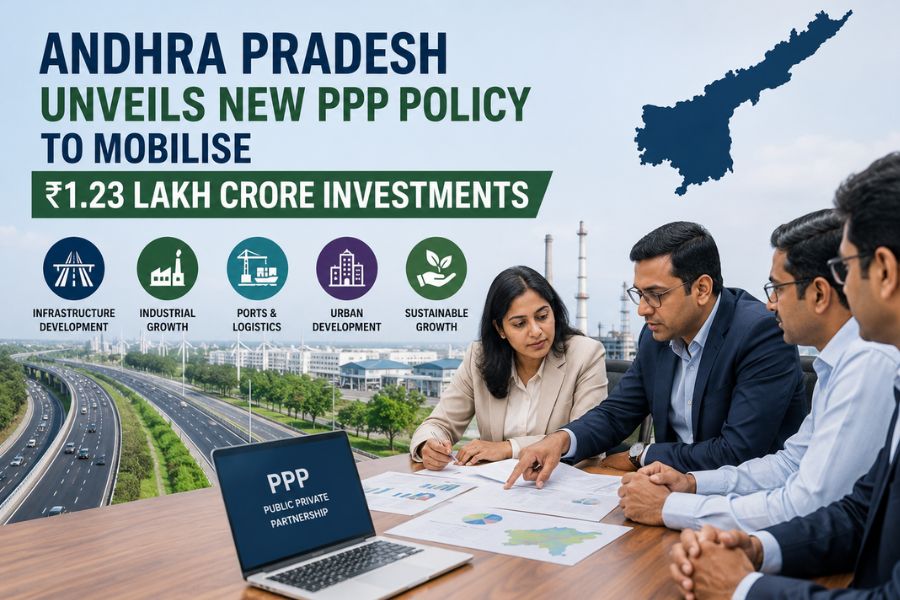
Amaravati: In a major push to accelerate infrastructure-led economic growth, the Andhra Pradesh Cabinet chaired by Chief Minister N. Chandrababu Naidu has approved the Andhra Pradesh Public-Private Partnership (PPP) Policy, 2026, laying out a comprehensive framework to attract large-scale private investment across infrastructure, transport, energy, tourism, healthcare and education.
The government has already identified an initial pipeline of PPP projects worth ₹1.23 lakh crore, making it one of the most ambitious public-private investment programmes undertaken by the State.
Focus on private investment
The new policy aims to leverage private capital and expertise to build world-class infrastructure while reducing the financial burden on the government. It also seeks to unlock the economic value of underutilised public assets and provide investors with a transparent and predictable policy environment.
Officials said the framework has been designed to improve investor confidence through clearly defined risk-sharing mechanisms and streamlined project implementation.
Wide range of sectors
The policy opens up several strategic sectors for private participation.
These include high-speed road corridors, bridges, logistics parks, ports, regional airports, renewable energy projects, pumped storage facilities, public healthcare infrastructure, higher education institutions, tourism projects and urban redevelopment initiatives.
Among the flagship projects expected to be developed under the PPP framework are the proposed Amaravati Eye observation wheel, redevelopment of the Velampeta slum in Visakhapatnam, commercial development of government land parcels and transport hubs, and modern logistics infrastructure.
₹1,500 crore Viability Gap Fund
Recognising that many large infrastructure projects require financial support during their initial years, the State has created a dedicated ₹1,500 crore Viability Gap Funding (VGF) pool.
The fund will provide capital grants to economically important projects that may not be immediately commercially viable, helping improve their financial sustainability and attract private investors.
The government has also introduced a State Bridge Fund, a new financing mechanism that will provide early-stage financial support for projects with long gestation periods and delayed revenue generation.
Multiple PPP models
Projects will be implemented through globally accepted PPP models such as Build-Operate-Transfer (BOT), annuity-based contracts, Public-Private-People Partnership (P4) models and long-term lease concessions, depending on the nature of the project.
Every government department has been directed to prepare medium- and long-term infrastructure plans based on the PPP framework.
Additional investor incentives
To improve project viability, the government has reduced APTransco supervision charges to 2.5% and exempted eligible projects from fixed development charges.
The policy also encourages commercial utilisation of underused government properties. Vacant land around APSRTC bus stations, for instance, will be developed into retail, commercial and transit-oriented hubs through private investment.
Key reform
The PPP Policy 2026 is expected to become a cornerstone of Andhra Pradesh’s investment strategy. By combining public assets with private capital and global expertise, the government aims to accelerate infrastructure development, improve public services and position Andhra Pradesh as one of India’s most attractive destinations for long-term infrastructure investment.