

From Our Special Correspondent
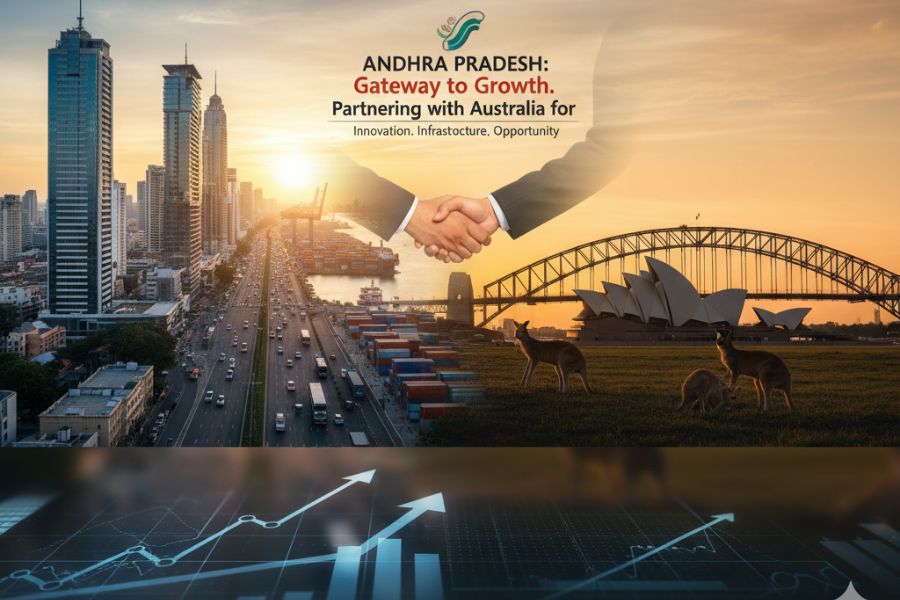
At a Melbourne gathering of Australia–India business leaders, Andhra Pradesh Economic Development Board Associate Vice-President Aju Antony laid out an ambitious playbook: a data-driven, cluster-led, logistics-anchored plan to turn the “Sunrise State” into a powerhouse by mid-century.
“More than a presentation—an invitation”
Antony’s opening line set the tone: this wasn’t a roadshow as much as a recruitment drive into Andhra Pradesh’s growth story. The state, he said, is where “ambition meets opportunity,” and the numbers he reeled off were designed to make the case. Andhra Pradesh spans 160,000 sq. km, houses 53 million people (about 4% of India’s population), and contributes a $180 billion economy with roughly $20 billion in exports. The vision by 2047 is starkly quantified: a $2.4 trillion contribution to India’s GDP, $42,000+ per-capita income, 100% literacy, 95% skilled workforce, 80% female labour force participation, and 60% urbanization.
This is “textbook transformation,” he argued—backed by a policy spine and execution muscle already in motion.
Pillars of the plan
1) Governance that enables.
Andhra Pradesh’s Industrial Development Policy 4.0 sits atop dozens of sectoral and thematic policies tuned to compress approvals, lower logistics costs, and hardwire sustainability and circular economy principles. The mantra is “speed of doing business,” not just ease.
2) Amaravati as control tower.
The greenfield capital is being framed as the state’s digital-and-design nerve center: Quantum Valley, a state data lake, AI-assisted decision layers, district cooling, underground utilities, 100% green buildings and an EV-first transport plan. The goal is to turn governance into an operating system—700+ services, paperless workflows, and real-time decisioning.
3) Logistics as competitive advantage.
With 1,053 km of coastline, six operational ports (about 330 MMT capacity) and four greenfield ports on the way, Andhra positions itself as the gateway to the East, already handling an estimated 40% of east-coast cargo. Layer onto that seven operational airports (with nine more being built), a 9,000-km rail grid, 160,000 km of roads, and 900 km of inland waterways. The state has also mapped 50 coastal sites for shipbuilding and maritime activity—a granular sign that land, linkages, and labour can be aligned at speed.
Cluster capitalism, Andhra-style
Antony’s core thesis is clusters—built vertically (full value chains within a 100-km radius) and horizontally (skilling, testing, certification, and research embedded alongside industry). Andhra’s menu spans electronics and semiconductors, aerospace and “space city,” drones, pharma and biotech, medical devices, renewables and green hydrogen, automotive, compressed biogas, steel, aqua and food processing—15+ sectors with explicit integration plans.
The logic is simple: clusters reduce friction, attract supplier ecosystems, accelerate learning curves, and hold talent. It’s “product perfection, speed, and cost—designed in partnership, delivered at scale.”
People first: from AP to AI
If logistics is backbone, talent is the muscle. Antony cast Andhra’s 38 million tech-skilling opportunity as a differentiator. Large-scale initiatives are aimed at AI and cloud, with a “talent is grown here” ethos. The Ratan Tata Innovation Hub ties marquee corporates to incubation and acceleration, while a fund-of-funds approach seeks to crowd in capital without bureaucratizing it. Grassroots entrepreneurship gets a push through the “One Family, One Entrepreneur” mission.
Tourism—with ecological guardrails
Andhra isn’t ignoring soft power. The state’s beaches, wildlife and heritage are being packaged into seven anchor hubs and 20 thematic circuits, underpinned by eco-preservation across three national parks and 13 sanctuaries. The projection: $2.9 billion in private tourism investment and a jump from ~20,000 to ~50,000 keys by 2029. The emphasis is on capacity and certification—tourism growth without overtourism.
Why Australia, why now
The pitch in Melbourne was tailored: renewables, critical minerals, education and skilling, maritime and logistics tech, agritech, climate resilience, sports science and infrastructure—all areas where Australian capability fits Andhra’s needs. The promise is a concierge-style “soft landing”: co-designed curricula with universities, certification labs inside clusters, and rapid clearances via tightly run approval cycles.
Antony’s line drew smiles: “Pick a sector—we’ll handle the rest.”
From slides to shovel-ready
Investors listen for execution, not just aspiration. Antony leaned on Andhra’s cadence: cabinet every 15 days, with special sittings for strategic projects; a focus on grounding rather than collecting MOUs; and a willingness to shepherd federal policy changes when required—most visibly in data-centre policy, helping catalyze a $15 billion commitment that Andhra says it intends to multiply many times over via supplier ecosystems and talent pipelines.
The corridor to watch
The narrative’s geographic centre of gravity is Visakhapatnam—positioned as an IT-innovation-data hub and the anchor of a Visakhapatnam Economic Corridor imagined at trillion-dollar scale by mid-century. Amaravati, as policy and digital core, completes the two-engine model.
The close: fear of missing out—by design
Antony’s final pitch was calibrated FOMO: Andhra has seeded ~$17 billion in recent investments with ~800,000 jobs, and the “train is moving.” The invitation was clear—see the momentum firsthand at the Partnership Summit in November—and test whether Andhra’s trademark claims of speed, certainty, and cluster depth match the brochure.
Bottom line: In a world where companies prize predictability, partners, and pipelines as much as incentives, Andhra Pradesh is betting that clusters + logistics + policy stamina can deliver compounding returns. If the state lands even a meaningful slice of what Antony sketched, the “Sunrise State” could be a case study in how sub-national ambition scales—quietly, methodically, and at speed.