

By Ramesh Kandula
Over the past few days, reports have circulated claiming that Heritage Foods Limited was caught selling “substandard” curd and penalised by food safety authorities. The headlines sound damning. But what exactly happened? And how serious is the issue in regulatory and business terms?
Here is a fact-based breakdown.
What triggered the action
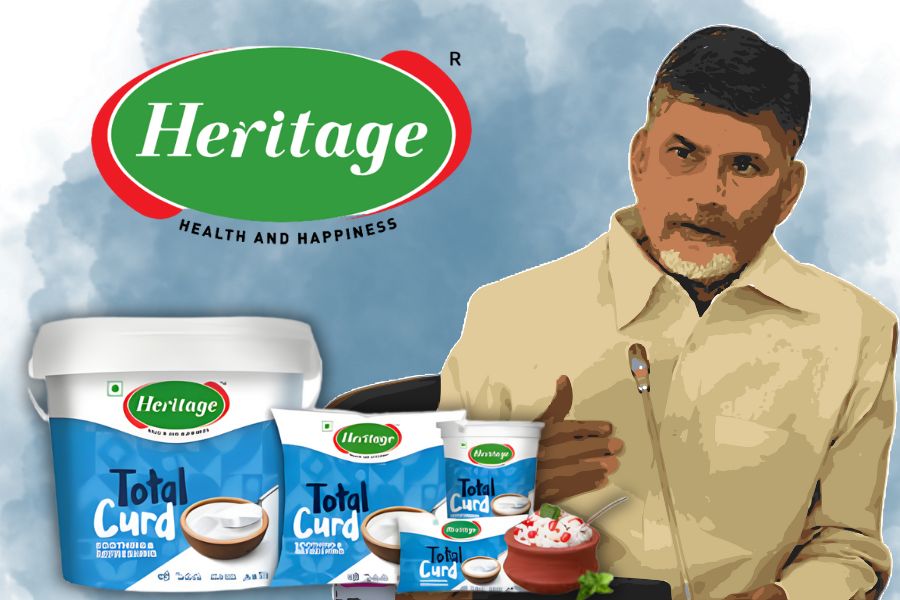
India’s food regulator, the Food Safety and Standards Authority of India (FSSAI), tested a sample of Heritage Total Curd collected during routine inspection. Laboratory analysis found that the milk fat content in that particular sample was below the minimum level prescribed under FSSAI regulations.
Under the Food Safety and Standards Act, products that fail to meet defined compositional standards — even if they pose no immediate health risk — are categorised as “substandard”. Based on this finding, the adjudicating authority imposed a ₹1 lakh penalty on Heritage Foods.
Why the company disclosed it
Heritage Foods is a listed company. Any regulatory action that could potentially affect investor perception must be disclosed to stock exchanges under SEBI rules. Accordingly, the company informed the exchanges that:
-
A penalty of ₹1 lakh had been imposed,
-
The issue related to one product sample,
-
The financial impact was negligible.
This disclosure, required by law, later became the basis for broader public interpretation.
Did Heritage admit fault or pay the fine?
No — not in the way it has been widely portrayed.
Heritage Foods has clarified that while it acknowledged receipt of the regulatory order, it did not pay the penalty. Instead, the company challenged the order before the Food Safety Appellate Tribunal in Gurugram.
The tribunal has since granted a stay on the penalty. As things stand, the matter is sub judice, and the penalty remains in abeyance until the appeal is decided.
On what grounds is the penalty being challenged?
The company’s appeal focuses on procedural lapses in sampling and testing, not on denying regulatory oversight. Key arguments include:
-
The curd sample was allegedly not stirred or homogenised before testing, which can distort milk fat readings.
-
Official records do not clearly state whether samples were taken from sealed retail packs or loose/opened containers, raising the possibility of sampling error.
-
The absence of independent witnesses during sample collection, which is mandated under testing protocols.
Heritage argues that these lapses compromise the reliability of the test result itself.
Is this a food safety issue?
Not in the way it is being made out to be.
This case does not involve adulteration, contamination, or harmful substances. It concerns one compositional parameter — milk fat — falling below the prescribed level in a single tested sample.
Regulatory experts note that such cases are routine in food regulation, especially as enforcement tightens across dairy and packaged food categories. A “substandard” tag does not automatically imply unsafe or harmful food.
Does this affect the company’s business?
Financially, no. A ₹1 lakh penalty is immaterial for a company with over ₹4,500 crore in annual turnover and a market capitalisation exceeding ₹6,000 crore.
Reputationally, however, food brands operate in a sensitive space. Even isolated regulatory findings can snowball into broader perception issues — which is precisely why companies contest such orders when they believe procedures were not followed.
The larger context
Heritage Foods, founded in 1992 by the family of Andhra Pradesh Chief Minister N. Chandrababu Naidu, has operated for over three decades in a politically charged environment. As a result, regulatory actions involving the company often attract scrutiny beyond their technical merits.
That context does not invalidate regulatory oversight — but it does underline the importance of separating facts from narrative.
Bottom line
-
One sample of Heritage Total Curd failed a milk fat parameter test.
-
FSSAI imposed a ₹1 lakh penalty.
-
Heritage Foods has appealed the order and secured a stay.
-
The case is pending before the appellate tribunal.
-
There is no finding of adulteration or health risk, and no conclusion yet on whether testing procedures were properly followed.
Until the tribunal delivers its verdict, the matter remains unresolved — and should be treated as such.