

From Our Correspondent
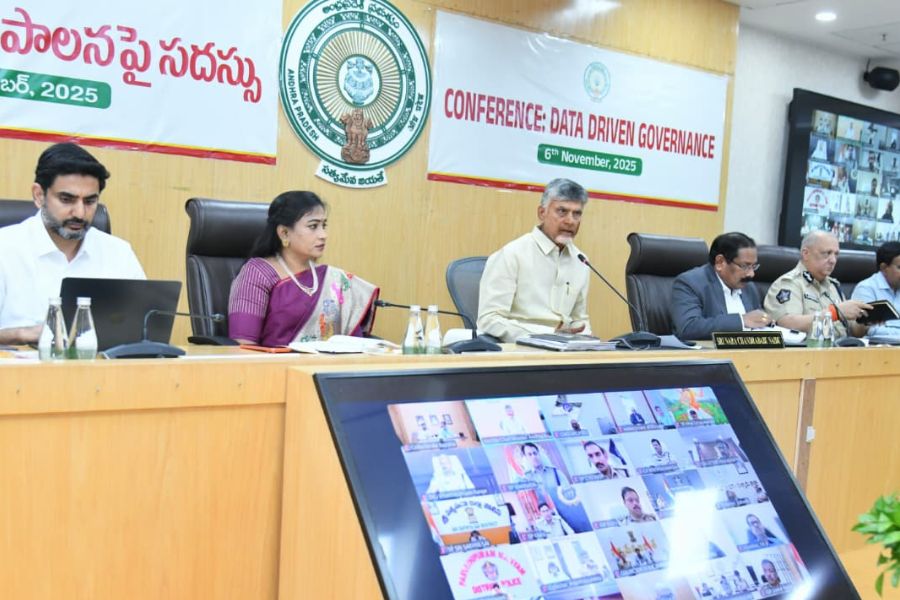
Amaravati: Chief Minister N. Chandrababu Naidu on Friday ordered a clean shift to end-to-end online delivery of government services, telling departments to stop calling citizens to offices and to fix laggards immediately. Chairing a review on data-driven governance at the AP Secretariat, he said Real-Time Governance (RTGS) facilities would be operational across all 26 districts by mid-December, backed by unified historical and real-time datasets.
Naidu said decisions must be data-first, with AI-enabled analytics and department-level dashboards. Non-sensitive datasets will be opened up to create a sandbox for startups and academia to build proof-of-concept solutions that the government can certify and scale. “Targets are not hard if data is right,” he told officials, pressing for 90–95% decision accuracy through better integration of online, historical and external data.
A pre-audit of grievance redressal flagged quality issues. Nearly half the sample was disposed of improperly, Naidu noted, warning that credibility suffers when cases are “closed” without real relief. Departments with heavy complaint loads—especially Revenue with legacy land and Section 22A problems—were told to streamline processes and fix records.
Performance tracking based on citizen feedback showed a mixed picture. Pensions have seen steady gains in on-time, at-home delivery and officer conduct. APSRTC improved on-time departures, staff behaviour and safety, but continues to lag on cleanliness, drinking water, toilets and schedule displays. Municipal and electricity services need sharper improvements, and property registration still shows corruption signals.
Linking the governance reboot to growth, Naidu said the state cannot afford a slower trajectory. He argued that compounding makes the difference over decades, and that sustained double-digit growth translates into materially higher per-capita income than middling single-digits.
The Chief Minister pushed a knowledge-economy play—AI, data centres and advanced tech—to lift incomes and jobs. He sought tighter institutional ties with IIT Tirupati and ISB, expanding RTGS use cases to disaster modelling, geospatial intelligence and operations management. Officials said RTGS today fuses feeds from drones, satellites, CCTV, sensors and IoT across 42 parameters.
On environment and industry, Naidu called for transparent, tech-led coastal pollution monitoring to counter misinformation that deters investment. Departments will share live lab methods and results with community representatives to build trust while enforcing strict air and water standards.
The Forest Department will deploy predictive fire models using weather and satellite data, intensify patrols in high-risk beats, track encroachment in real time and map resources—including carbon stocks—through RTGS. With major reservoirs about 90% full and groundwater up, Naidu asked departments to cut agricultural power draw through efficiency—arguing that halving today’s subsidy burden could save roughly ₹4,500 crore.
Directing collectors, SPs, secretaries and heads of departments to “fix what’s not working and publish the proof,” Naidu said the administration will now judge itself on quality of outcomes, not counts of files closed.