

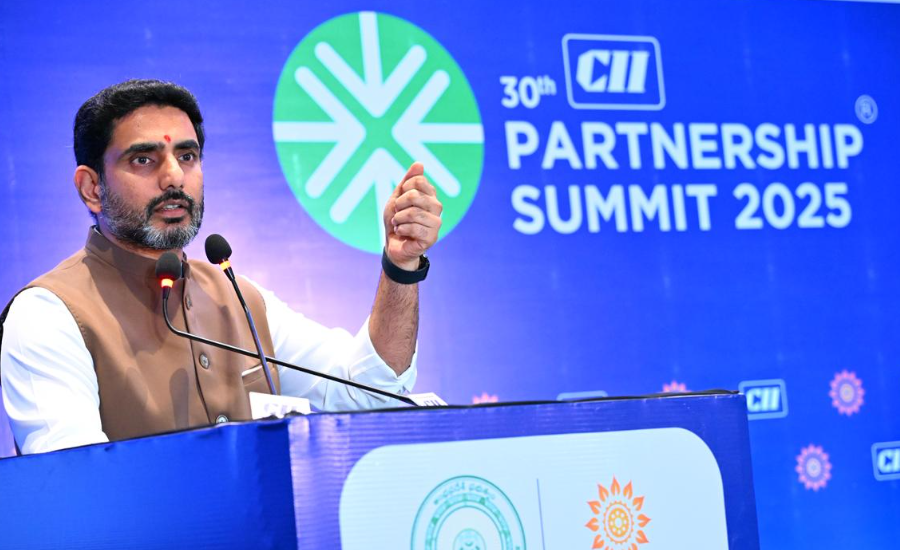
At Mumbai roadshow for CII Partnership Summit 2025, the IT and HRD Minister blends humour, hard data, and confidence to position Andhra as the country’s “startup state with the discipline of a Fortune 500 company.”
Mumbai: At the prelude to the 30th CII Partnership Summit 2025, Andhra Pradesh’s IT, Electronics and HRD Minister Nara Lokesh delivered a sharp, data-rich and self-assured pitch before a hall of CEOs, diplomats, and industrialists in Mumbai.
His message was simple but strategic: Andhra Pradesh is open for business—and it moves faster than any other Indian state.
The upcoming Partnership Summit, scheduled for November 14–15 in Visakhapatnam, will focus on the theme “Technology, Trust, and Trade: Navigating the New Geoeconomic Order.” Lokesh’s speech set the tone for what the state plans to showcase—a blend of leadership credibility, governance efficiency, and industrial momentum.
Framing his presentation around “three reasons to invest in Andhra Pradesh,” Lokesh built his argument with examples of agility, clarity, and ambition.
Lokesh began by crediting Chief Minister N. Chandrababu Naidu, describing him as a “visionary who has built two modern cities in two eras.”
“During his first two terms, he built Cyberabad, which today powers Telangana’s IT economy,” Lokesh said. “In his third term, he brought KIA Motors to Anantapur—then one of India’s most backward districts—which has since tripled its per capita income.”
He argued that such leadership continuity gives investors “predictability in an unpredictable world.”
Positioning Andhra as a “startup state with the agility of a startup and the discipline of a Fortune 500 company,” Lokesh underscored the state’s governance model: “Once an investor commits, the project becomes our project. We become partners in execution.”
He backed the statement with quick, verifiable examples:
-
ArcelorMittal Steel Plant – “India’s largest steel plant deal was done over a Zoom call and confirmed on WhatsApp the next morning,” Lokesh recalled. “The project was grounded in less than 15 months—without an MoU.”
-
Google Data Centre – The ₹87,520-crore, 1-gigawatt project in Visakhapatnam, whose agreement will be signed this month, followed policy changes initiated by the state in coordination with the Union government.
-
Reliance Industries CBG Project – A ₹40,000 crore green energy investment spread across eight nodes. The state leased 80,000 acres of arid land to cultivate Napier grass for compressed biogas feedstock “in just eight months.”
-
TCS & Cognizant – “We allotted TCS 25 acres at 99 paise per acre; their centre launches on November 1. Cognizant and several others are following,” Lokesh said.
-
Energy Reform – “We cut power tariffs by 13 paise per unit in 17 months,” he said, calling it “a bold reform that industry understands better than politics.”
Lokesh added that the current government, which won 94% of contested seats, has “raw energy and passion,” with half of its ministers serving for the first time.
Lokesh outlined Andhra’s model of industrial clusterization—the practice of vertically and horizontally integrating entire ecosystems around anchor investments.
In vertical integration, he cited the air-conditioning manufacturing cluster, which produces 50% of India’s AC units today and targets 70% within two years. “We want every component—from compressors to circuit boards—to be made within 100 kilometres.”
In horizontal integration, Andhra is aligning industrial growth with skilling, education, and R&D, ensuring that every major cluster includes technical institutes, testing centres, and support services.
The KIA Motors model in Anantapur, where incentives extended to ancillaries built a full-fledged auto ecosystem, is being replicated in aerospace, electronics, and renewables.
Sectors of Focus: From Space to Shrimp
Lokesh’s address wasn’t short on ambition. He listed several upcoming sectoral initiatives:
-
Space City: 300 acres cleared for Skyroot to build India’s first private space launch complex.
-
Quantum Computing: South Asia’s first 158-qubit quantum computer to be housed in Amaravati.
-
Electronics Manufacturing: Two districts dedicated entirely to electronics and semiconductor industries.
-
Agriculture & Aqua: “Andhra is the number one shrimp exporter in the world,” Lokesh said, “and we’re diversifying into high-value crops like dragon fruit, mango, and banana.”
-
AI & Skilling: The Niponium platform—launching in November—will connect job seekers, industries, and training institutes in real time.
Visakhapatnam and Amaravati: The Twin Engines
In one of his lighter moments, Lokesh described Visakhapatnam as “if Bangalore were to marry Goa and have a child”—a city that combines “livability with global competitiveness.” He said it will serve as the anchor for the Visakhapatnam–Amaravati–Tirupati economic corridor, which will define Andhra’s growth map to 2047.
Amaravati, meanwhile, is being reimagined as a greenfield capital and innovation hub, featuring a 200-acre Health City and South Asia’s first Quantum Computing Centre.
Under the state’s long-term roadmap, Swar Andhra Pradesh at 2047, the government aims to grow the state’s economy to USD 2.4 trillion and raise per capita income to USD 42,000.
Lokesh closed his address by emphasizing that Andhra Pradesh’s governance philosophy rests on “trust, technology, and time-bound delivery.”
“We’ve institutionalized the speed of doing business,” he said. “Our WhatsApp Governance platform delivers 200 public services directly to citizens’ phones. For investors, that same efficiency applies—we don’t just promise; we deliver.”
The Mumbai roadshow was more than a pitch—it was Andhra Pradesh’s declaration of intent. With Naidu’s leadership and Lokesh’s technocratic drive, the state is positioning itself not as another investment destination but as a model of execution, governance, and innovation in India’s next growth story.