

By Ramesh Kandula
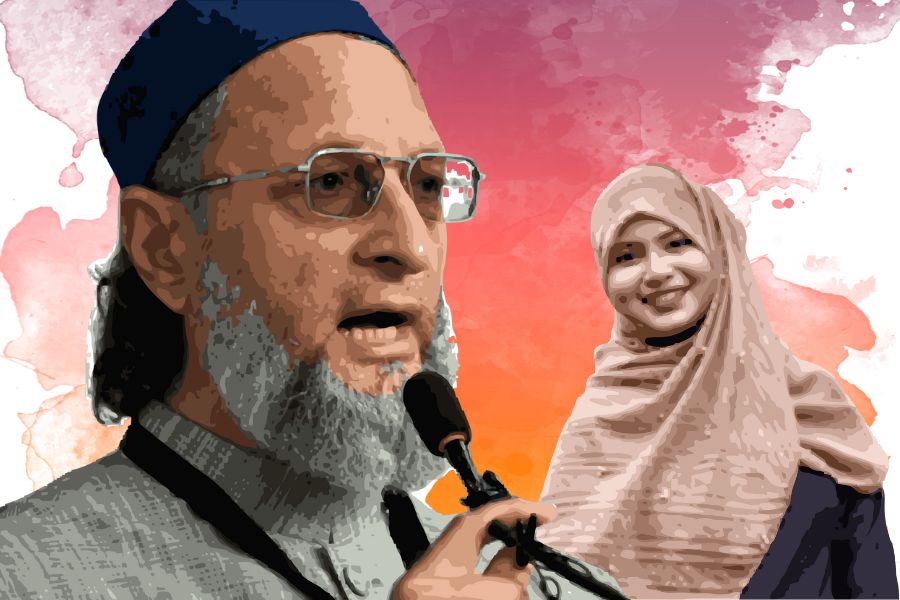
When MIM leader Asaduddin Owaisi said he dreams of seeing a hijab-clad woman become India’s Prime Minister, the line sounded progressive at first glance. Scratch the surface, and the claim collapses under its own contradictions.
Owaisi made the remark while campaigning for local body elections in Maharashtra. The context he invoked was familiar: unlike Pakistan, where the Constitution restricts top offices to Muslims, India’s Constitution—drafted under the leadership of B. R. Ambedkar—allows any citizen, irrespective of religion, to become Prime Minister, President, or Chief Minister. That point is unexceptionable. It is also old news.
India has already had Muslim Presidents such as Fakhruddin Ali Ahmed and A. P. J. Abdul Kalam. It has had a Sikh Prime Minister—Manmohan Singh—who governed for a full decade without his faith ever defining his legitimacy. So the idea that a Muslim could occupy the highest constitutional office is neither radical nor aspirational. It is settled constitutional practice.
That is precisely why Owaisi’s formulation is troubling.
If he had said he hopes to see a Muslim woman become Prime Minister, it would still be a statement of representation—arguable, but defensible. Instead, he insisted on a hijab-clad woman. That qualifier changes everything. It shifts the focus from citizenship to religious symbolism, from equality to assertion.
In a constitutional democracy, the Prime Minister does not sit in office as a Hindu, Muslim, Sikh, or Christian representative. She or he represents the entire country. Identity does not vanish, but it is not the credential. No Prime Minister has ever been judged—at least in principle—by religious markers. Jawaharlal Nehru was openly secular. Indira Gandhi was not defined by ritual piety. Even Atal Bihari Vajpayee, leading a BJP government, did not turn religious identity into his governing persona. And Narendra Modi, whatever his political use of Hindu symbolism, does not occupy office because he is Hindu.
Owaisi’s stress on the hijab sends a different message: that visible religious markers are not just personal choices but political qualifications. It implies that a Muslim woman who does not wear the hijab is somehow less authentic. That is a deeply conservative—and frankly regressive—position. Many Muslim women, in India and across the Islamic world, argue precisely the opposite: that wearing the hijab should be optional, not compulsory, and certainly not a test of faith.
The irony is hard to miss. Even in Saudi Arabia, long seen as socially rigid, women have fought to make the hijab a matter of choice rather than coercion. Against that backdrop, an Indian MP projecting the hijab as the defining feature of Muslim womanhood is not progressive politics. It is identity policing.
More importantly, this rhetoric mirrors the very politics Owaisi claims to oppose. When the BJP emphasizes Hindu symbols, critics rightly call it majoritarianism. When Owaisi emphasizes Muslim symbols in the same way, the logic does not become secular simply because the minority is different. Extremes feed off each other. One side’s religious assertion becomes the other’s justification.
India’s Constitution does not promise representation through religious costume. It promises equality of opportunity. A woman—Muslim, Hindu, or otherwise—becoming Prime Minister would indeed be a milestone, and India had already done it. But reducing that aspiration to a piece of clothing cheapens the idea and narrows the republic.
The problem, then, is not the dream of a Muslim woman Prime Minister. The problem is the insistence that she must first look the part. In a secular democracy, that is not progress. It is a step sideways—if not backwards.
1 Comment