

From Our Correspondent
Amaravati: Andhra Pradesh is preparing to roll out a new Public-Private Partnership (PPP) policy as it looks to accelerate infrastructure development and attract massive private investments under its Swarna Andhra 2047 Vision.
Chief Minister N. Chandrababu Naidu on Thursday said Viability Gap Funding (VGF)-supported PPP projects would play a crucial role in building the state’s infrastructure over the coming decades. He directed officials to place the Andhra Pradesh PPP–VGF Policy 1.0 before the next Cabinet meeting and issue detailed implementation guidelines at the earliest.
Why the New PPP Policy?
The state government believes PPP is the most effective way to build large infrastructure projects while reducing the financial burden on the government. Under the model, private companies invest in projects, while the government provides policy support and, where necessary, financial assistance through Viability Gap Funding (VGF) to make commercially important projects financially viable.
Naidu said India has moved from an era of economic reforms to an era of infrastructure development and stressed that Andhra Pradesh should take full advantage of this opportunity.
He said every PPP project should be financially sustainable and generate economic activity instead of functioning as a standalone infrastructure asset.
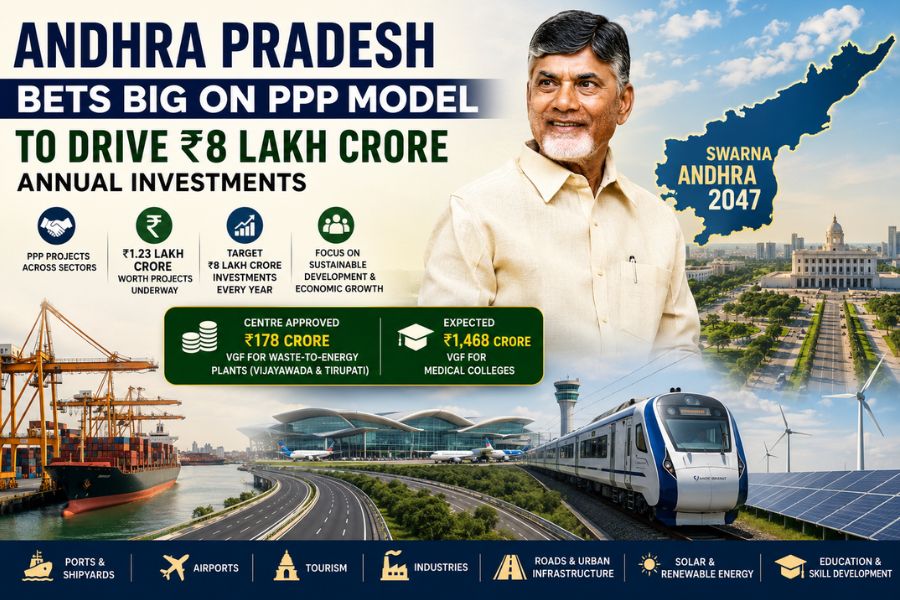
₹1.23 Lakh Crore Worth of Projects Underway
Officials informed the Chief Minister that Andhra Pradesh is currently implementing 260 PPP projects across sectors including ports, shipyards, airports, tourism, industries, roads, urban infrastructure, solar energy and medical colleges.
These projects together represent an investment of ₹1,23,229 crore.
The government expects infrastructure investments to be concentrated in the Visakhapatnam, Amaravati and Tirupati Economic Regions, which are being developed as major growth centres.
Officials also projected that the state could attract ₹8 lakh crore in investments every year through PPP projects in line with the Swarna Andhra 2047 Vision.
Centre Backing Key Projects
The meeting was informed that the Centre has already sanctioned ₹178 crore in Viability Gap Funding for Waste-to-Energy plants in Vijayawada and Tirupati.
The state is also expecting ₹1,468 crore in VGF for upcoming medical colleges. According to officials, the Department of Economic Affairs, Government of India, has appreciated Andhra Pradesh’s PPP model for developing medical colleges.
Focus on Tourism, Ports and Renewable Energy
Naidu directed officials to ensure that local fishermen become stakeholders in coastal tourism projects so they directly benefit from tourism-led development.
He also asked officials to improve infrastructure and create economic activity zones around 21 major temples across the state to promote religious tourism.
The Chief Minister called for better institutional mechanisms to manage ports, airports and other major infrastructure assets.
He also instructed departments to promote pumped storage hydropower, solar power projects, and commercial utilisation of unused government land, including land available at bus stations, through the PPP model.
Revenue Generation a Priority
Naidu said every government department should prepare short-, medium- and long-term financial plans to improve revenue generation.
He noted that supplying water to industries could create a new revenue stream for the Water Resources Department, while sectors such as mining, tourism, logistics and renewable energy also offer significant revenue potential.
He stressed that PPP projects should be implemented in a way that builds investor confidence and gives Andhra Pradesh a first-mover advantage in emerging sectors.
Education Also on the Agenda
The Chief Minister also reviewed education infrastructure and directed officials to prepare plans for establishing integrated residential schools as mini townships in urban areas.
He said the government aims to double the number of students studying in SC, ST, BC and Minority residential institutions and develop them into highly skilled graduates capable of securing admission to premier institutions such as the IITs and IIMs.
The proposed PPP policy is expected to become the state’s key framework for mobilising private capital, expanding infrastructure and supporting Andhra Pradesh’s long-term economic growth.