

By Ramesh Kandula
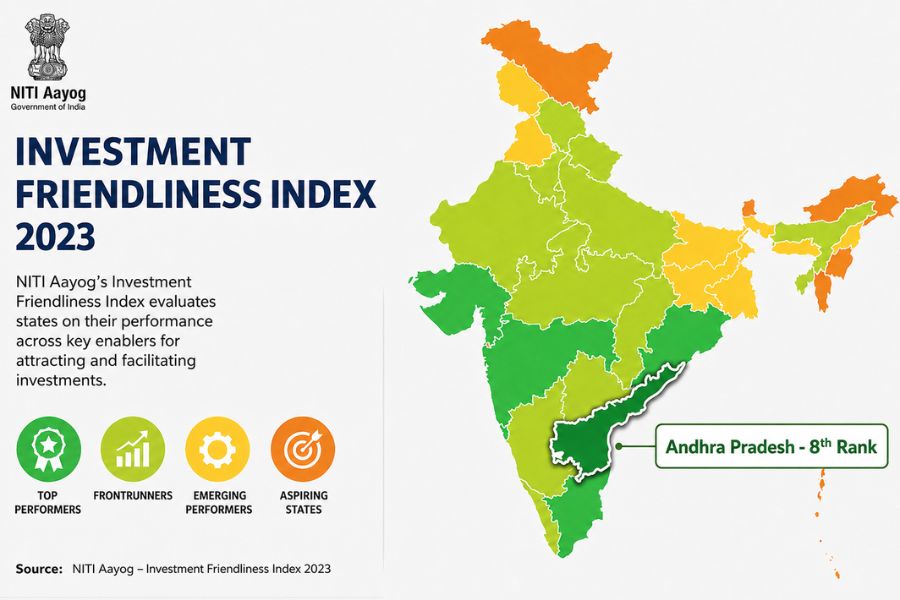
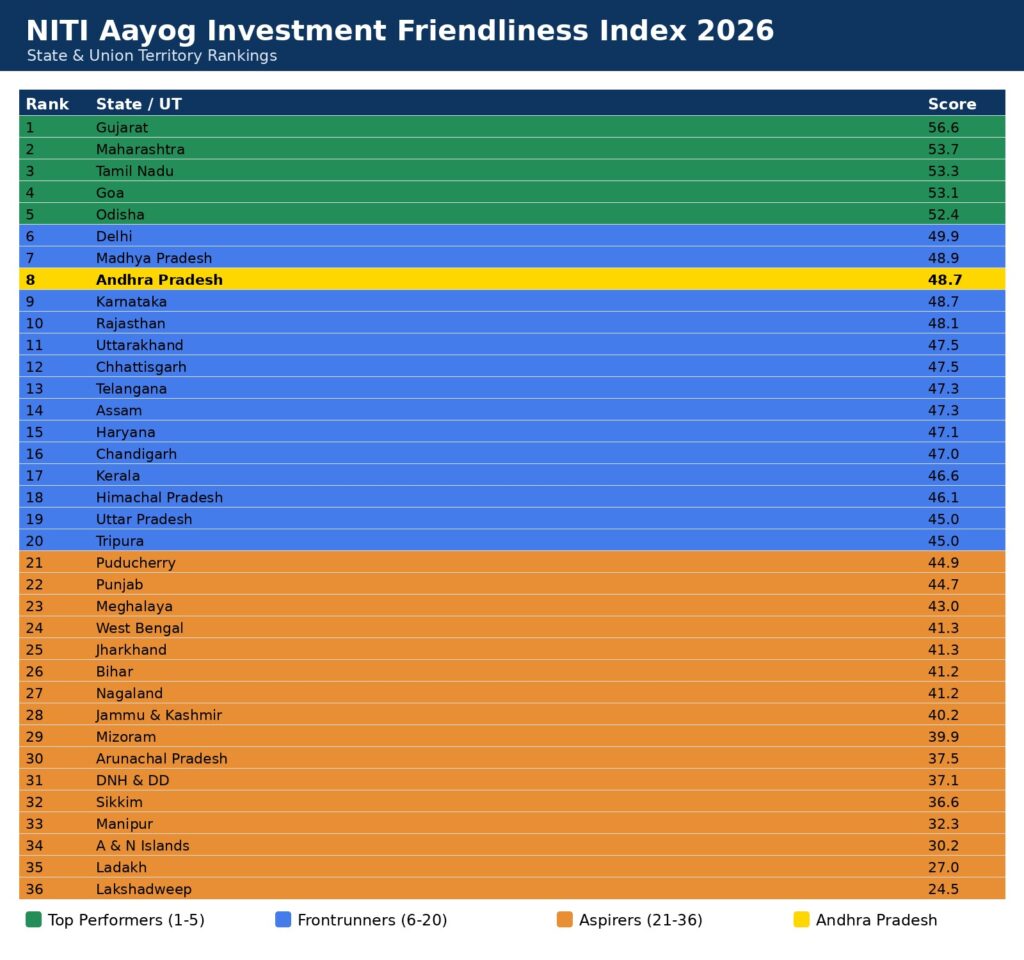
Andhra Pradesh has been recognised as one of India’s most investment-friendly states, securing a place in the ‘Frontrunners’ category in the NITI Aayog Investment Friendliness Index (IFI) 2026. The state ranked sixth among large states and eighth overall with a score of 48.7 out of 100, reinforcing its position as a preferred destination for investors despite missing the elite ‘Top Performer’ category.
The rankings come at a time when Andhra Pradesh has been attracting record investment commitments, prompting questions over why it failed to break into the top five alongside Gujarat, Maharashtra, Tamil Nadu, Goa and Odisha.
Investment commitments alone do not determine rankings
The apparent contradiction lies in the methodology adopted by NITI Aayog.
While Andhra Pradesh accounted for 25.3% of all proposed capital investments in India during the financial year, the Investment Friendliness Index is not based solely on investment announcements or MoUs. Instead, it evaluates states across 84 indicators grouped under eight key pillars, including financial health, business climate, infrastructure, governance, digital readiness, human capital and sustainability.
This means that although the state has emerged as India’s leading destination for new industrial investments, weaknesses in other structural parameters affected its overall score.
Fiscal health remains the biggest concern
According to the index, financial health was the principal factor limiting Andhra Pradesh’s ranking.
The state continues to carry a significant public debt burden while simultaneously implementing large-scale welfare programmes. High outstanding liabilities and limited fiscal headroom reduced its score under the Financial Health pillar, an area closely watched by institutional investors assessing the long-term sustainability of infrastructure spending.
States with stronger fiscal balances, such as Gujarat, scored considerably better in this category, helping them secure higher overall rankings.
Business climate affected by policy continuity
Another area where Andhra Pradesh fell short was the Business Climate pillar, where it ranked ninth nationally.
Although the state has significantly improved the speed of approvals and investor facilitation under the current government, the index also measures long-term regulatory stability and policy continuity.
Analysts note that policy uncertainty during previous years, particularly regarding the capital city project and industrial land policies, influenced perceptions of regulatory predictability, impacting the state’s score.
It may be recalled that during the tenure of the Y.S. Jagan Mohan Reddy government, the Amaravati capital project became the subject of prolonged policy uncertainty, while frequent changes in industrial policy affected investor confidence.
Strong fundamentals continue to attract investors
Despite these challenges, the report highlights several areas where Andhra Pradesh has emerged as a national leader.
The state recorded the highest digital transactions per capita in India, averaging around 18 transactions per person, compared with the large-state average of 4.8.
Power infrastructure also remains one of Andhra Pradesh’s biggest strengths. The state provides an average of 23.71 hours of daily electricity supply, while maintaining transmission and distribution losses at around 14%, making it an attractive destination for manufacturing, electronics and data centre investments.
In addition, Andhra Pradesh’s extensive coastline, availability of industrial land and skilled workforce continue to strengthen its investment appeal.
These advantages have helped the state secure several marquee projects, including Google’s proposed US$15-billion data centre cluster in Visakhapatnam, alongside major investments in renewable energy, electronics, logistics and advanced manufacturing.
Path to the ‘Top Performer’ category
State officials believe the latest rankings validate Andhra Pradesh’s industrial competitiveness while identifying areas requiring further reforms.
The government is focusing on improving fiscal discipline, strengthening district-level project monitoring, accelerating land allotments and ensuring policy stability to address the shortcomings identified by NITI Aayog.
If Andhra Pradesh succeeds in improving its macroeconomic indicators while sustaining its current momentum in industrial development and investment attraction, analysts believe the state is well positioned to enter the ‘Top Performer’ category in future editions of the Investment Friendliness Index.
2 Comments