

From Our Correspondent
Amaravati: For decades, Rayalaseema was known for drought, uncertain rainfall and low farm incomes. Today, however, Lingala mandal in the Pulivendula region of YSR Kadapa district is proving that technology-driven horticulture can transform the rural economy.
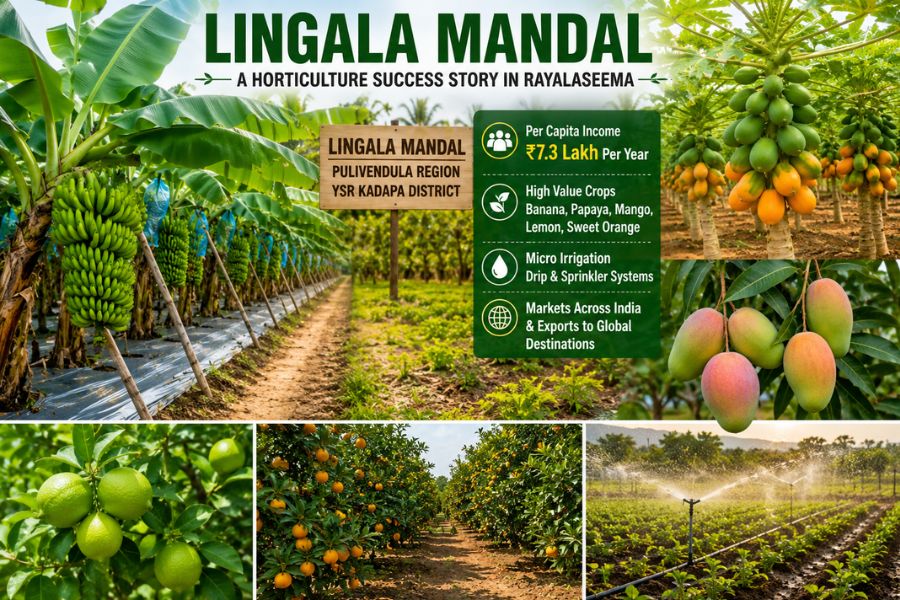
The mandal has recorded an impressive per capita annual income of around ₹7.3 lakh, making it one of the highest-income rural regions in Andhra Pradesh. Its success is now being seen as a model for the rest of Rayalaseema.
From rain-fed farming to high-value horticulture
The transformation began when farmers gradually shifted away from traditional rain-fed crops such as groundnut to high-value horticulture.
Today, thousands of acres in Lingala are covered with orchards and fruit plantations instead of conventional field crops.
The major crops grown include G9 Cavendish bananas, Taiwanese papaya, sweet orange (mosambi), acid lime and mango. These crops offer significantly higher returns per acre than traditional agriculture.
Technology drives growth
A key reason behind Lingala’s success is the widespread adoption of modern farming techniques.
Farmers have invested heavily in drip irrigation, sprinkler systems, tissue-culture plants, plastic mulching and shade-net nurseries, helping them conserve water while improving yields and crop quality.
Large-scale use of micro-irrigation has also made farming more resilient to drought, a crucial advantage in the dry Rayalaseema region.
Produce reaches markets across India and overseas
Most of Lingala’s produce is not sold in local markets.
Instead, traders purchase fruits directly from farms and transport them daily to major consumption centres including Hyderabad, Bengaluru, Chennai, Mumbai and New Delhi.
A sizeable quantity of premium bananas and papayas is also exported to Middle Eastern countries, Europe and Southeast Asia through cold-chain logistics, providing farmers with access to international markets.
Higher incomes, rising land values
The shift to commercial horticulture has significantly improved farm incomes.
Higher productivity and better market access have not only increased farmers’ earnings but have also led to a sharp rise in agricultural land values across the mandal.
The success has created employment opportunities in cultivation, harvesting, grading, packing, transportation and logistics, benefiting the wider rural economy.
A model for Rayalaseema
Recognising Lingala’s success, the Andhra Pradesh government is studying the model to replicate it in other parts of Rayalaseema.
The state plans to establish horticulture clusters, food processing units, cold storage facilities and value-addition centres to strengthen the supply chain and help farmers earn better prices.
Officials believe that expanding the Lingala model could reduce dependence on rain-fed agriculture, increase exports and transform Rayalaseema into a major horticulture hub.
As Andhra Pradesh focuses on high-value agriculture and food processing, Lingala stands out as an example of how the right mix of technology, irrigation, market access and farmer entrepreneurship can dramatically improve rural incomes.