

From Our Correspondent
Amaravati: In a significant step towards regulating street vending while protecting the livelihoods of thousands of hawkers, the Andhra Pradesh government has notified Street Vending Plans for 51 Urban Local Bodies (ULBs) under the Street Vendors (Protection of Livelihood and Regulation of Street Vending) Act, 2014.
The notification, issued by the Municipal Administration and Urban Development (MA&UD) Department through G.O. Ms. No. 140, covers three municipal corporations—Nellore, Srikakulam and 48 municipalities including Bhimavaram, Hindupur, Kurnool, Tadipatri, Palasa-Kasibugga, Bobbili, Rajampet, Gudur, Kandukur, Samalkot and Vizianagaram.
MA&UD Minister P. Narayana said the initiative aims to strike a balance between protecting the livelihoods of street vendors and ensuring orderly urban development. The notified plans identify vending zones, restricted vending zones and non-vending zones, enabling vendors to carry out their business without fear of arbitrary eviction while ensuring roads, footpaths and public spaces remain accessible and safe for citizens.
Under the framework, vendors will be permitted to operate only through temporary and removable stalls without permanent structures. They will be required not to obstruct traffic, pedestrian movement, emergency access or public visibility, while maintaining hygiene in vending areas.
The government has directed Principal Secretary S. Suresh Kumar to prepare vending plans for all remaining ULBs in phases. Local bodies have also been asked to revise the plans every five years in consultation with Town Vending Committees and integrate them with master plans and other urban planning documents.
A long-standing urban challenge
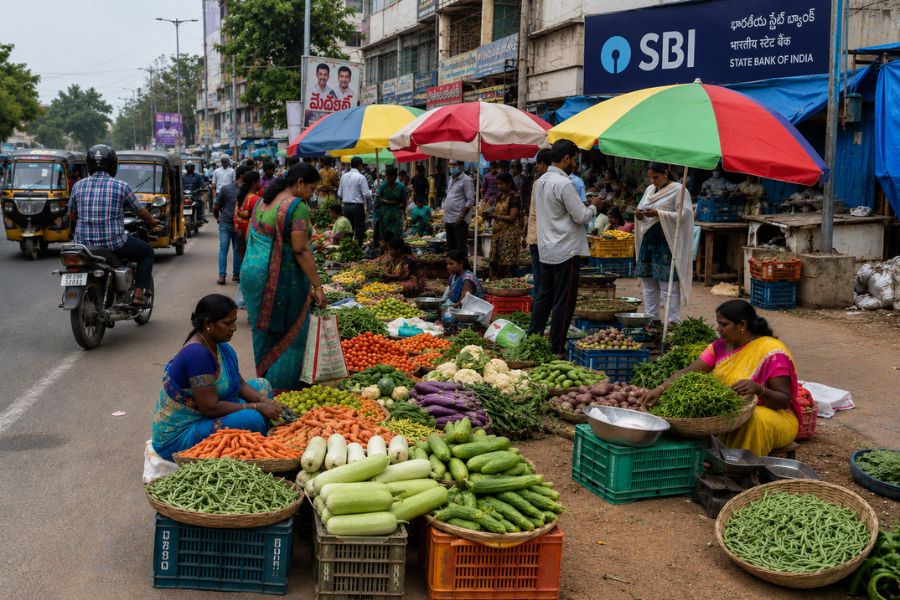
Street vending has emerged as one of India’s most complex urban governance issues. Millions of people depend on vending for their livelihood, while residents and commuters often complain about encroachments on roads and footpaths, traffic congestion, sanitation problems and obstruction of pedestrian movement.
In many Indian cities, the absence of clearly demarcated vending zones and inconsistent enforcement has resulted in frequent conflicts between municipal authorities, shopkeepers, vendors and the public. Vendors have often faced eviction drives despite the legal protections available under the 2014 Act, while civic bodies have struggled to balance economic activity with urban mobility.
By creating notified vending plans, the Andhra Pradesh government seeks to provide certainty to vendors while enabling civic authorities to regulate public spaces more effectively.
Is this the first such mechanism in India?
No. The legal framework itself is not the first of its kind in India. It is based on the Street Vendors (Protection of Livelihood and Regulation of Street Vending) Act, 2014, a central legislation that requires states and urban local bodies to prepare vending plans, conduct surveys and establish Town Vending Committees.
Andhra Pradesh had already notified its State Street Vending Scheme in 2016 under the Act.
However, the notification of Street Vending Plans for 51 ULBs marks one of the state’s most extensive implementations of the Act and is expected to accelerate the creation of regulated vending zones across Andhra Pradesh. Earlier, Visakhapatnam was among the first cities in India to prepare a fully digitalised street vending plan and identify vending zones.