

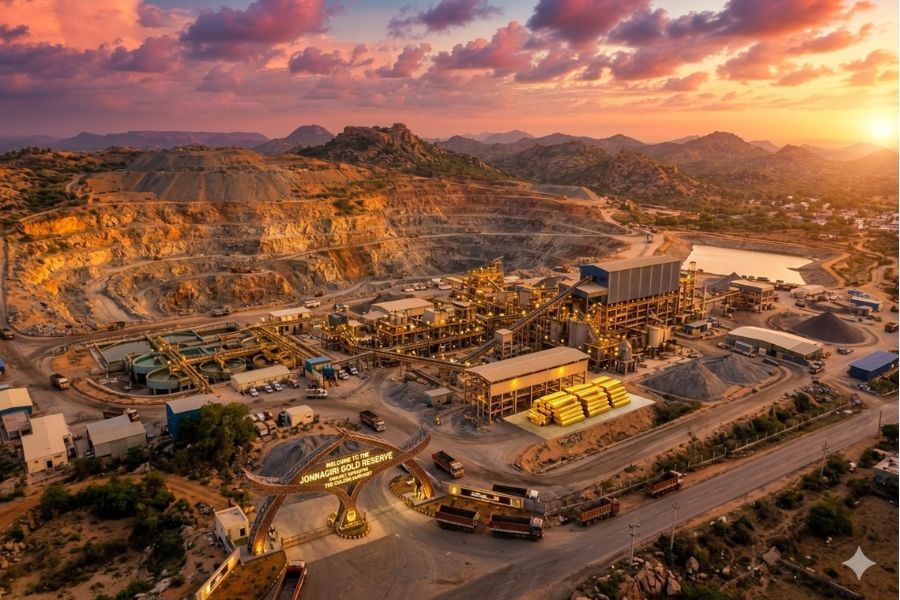
The launch of the Jonnagiri Gold Mine in Andhra Pradesh marks a historic shift as India’s first large-scale private gold mine with integrated processing setup since Independence. Below is a detailed breakdown of the project formatted in a question-and-answer structure.
🪙 Project Foundations & Reserves
Q: Where exactly is the Jonnagiri gold mine located?
A: The mine is located in the Kurnool district of Andhra Pradesh, spread over roughly 1,500 acres of land encompassing the villages of Jonnagiri, Erragudi, and Pagidirayi within the Tuggali Mandalam region.
Q: What are the available gold reserves confirmed at the site?
A: The project features a two-tiered reserve estimate based on ongoing exploration:
Confirmed/Certified Reserves: 13.1 tonnes of gold have been officially verified within the initial 500-acre explored segment.
- Projected Total Reserves: State mining authorities expect overall reserves to touch 50 tonnes (50,000 kg) once geological surveys expand across the remaining 1,000 acres.
📦 Extraction Targets & Scale
Q: How much gold will be extracted from the Jonnagiri mine every month?
A: The extraction and refining output is scheduled across a structured, multi-year scale-up strategy:
- Initial Phase: The project expects to produce around 400 kg to 600 kg during its immediate introductory year. This averages out to roughly 33 to 50 kg of refined gold per month.
- Commercial Baseline: Once full stabilization is complete, the operational target is 750 kg annually, equating to 62.5 kg of gold per month.
- Peak Output Target: Within the next 2 to 3 years, production will ramp up to 1,000 kg (1 tonne) per year, which yields approximately 83.3 kg of refined gold every month.
🌐 Comparison with India’s Gold Imports
Q: How does Jonnagiri’s production compare with India’s overall gold imports?
A: While historic for domestic mining, Jonnagiri’s output represents a small fraction of India’s massive commercial demand:
- National Import Scale: India is the world’s second-largest consumer of gold, importing roughly 750 to 1,000 tonnes of gold annually. It ranks as the country’s second-highest import expense after crude oil.
- The Comparison: At its peak output of 1 tonne per year, the Jonnagiri mine will fulfill roughly 0.1% of India’s annual import volume.
- The Domestic Impact: Despite being tiny compared to total imports, it significantly boosts India’s negligible domestic production, which has historically stagnated at just 1.5 tonnes per year (mostly from the state-run Hutti Gold Mines in Karnataka).
🏢 Corporate Players & Local Sales
Q: Which companies are mining the Jonnagiri gold reserves?
A: The project is executed via a private consortium consisting of key mining and exploration specialists:
- Geomysore Services India Pvt. Ltd. (GMSI): The primary leaseholder and operating developer managing the open-pit mining and on-site processing facilities.
- Deccan Gold Mines Ltd. (DGML): India’s first listed private gold exploration company, which acts as the major parent/investor backing the project.
- Thriveni Earthmovers: A prominent contract mining firm providing critical technology, execution, and earth-moving infrastructure support.
Q: Why is there a strategic push to sell the gold directly to local jewellers?
A: Selling the refined doré bars locally helps bypass traditional, multi-layered international supply chains. It provides localized jewelry hubs in South India with immediate, highly reliable access to primary gold, saving on logistics and transaction premiums. It also keeps the associated economic value and trade liquidity circulating entirely within the state economy.
🌿 Government Efforts & The Local Eco-system
Q: What efforts is the Andhra Pradesh government making to build an ecosystem around the mine?
A: Under the “Swarna Andhra 2047” long-term economic vision, the state government is leveraging the mine to uplift the entire region:
- Administrative Rebranding: In a symbolic move to highlight its transformation into a mineral hub, the government plans to officially rename the local village from Jonnagiri to “Swarnagiri” (Mountain of Gold).
- Local Employment: The state has tied regulatory support to job generation, with the facility creating over 600 direct industrial jobs alongside extensive indirect roles in transport, trade, and services for local youths.
- Financial Compensation Policies: To ensure community collaboration, local farmers who leased or sold parts of the 1,500-acre tract receive structured annual lease compensations or fixed multi-lakh land purchase payouts.
- State Revenue Flow: The project secures a 4% mineral royalty for the state exchequer, projected to bring in approximately ₹57 crore in its first stabilized year alone, which will fund regional infrastructure.
The Jonnagiri Gold Mine features an integrated, state-of-the-art on-site processing plant engineered to convert hard rock formations into high-purity doré gold bars. Because modern geological yields at the site require processing roughly one tonne of mined rock to recover just one gram of gold, the plant relies on a highly efficient, high-volume extraction workflow.
⚙️ Core Processing Technology
- Open-Pit Extraction: The ore is first extracted via open-pit mining involving precision drilling and blasting.
- Multi-Stage Crushing and Grinding: The hard rock formations are transferred to a primary and secondary crushing unit, followed by a Ball Mill system that grinds the ore into a fine, muddy pulp.
- Carbon-in-Leach (CIL) Processing: The core chemical extraction relies on advanced CIL technology. The ground ore slurry is introduced into a series of leaching tanks where a cyanide solution dissolves the gold. Simultaneously, activated carbon is introduced into the same tanks to adsorb (bind) the dissolved gold from the liquid. This combined method drastically improves gold recovery rates from low-grade, muddy, or oxidized ores.
- Desorption & Electrowinning: The gold-loaded carbon undergoes a desorption process to strip the gold back into a concentrated solution. This solution passes through electrolytic cells where the gold is deposited onto cathodes via electrowinning.
- Modern Smelting Furnaces: The recovered gold is finally melted in high-temperature on-site induction smelting furnaces to pour the final high-purity gold bars.
📊 Plant Capacity & Scaling
- Current Baseline: The plant currently handles a processing capacity of 1,000 tonnes of ore per day.
- Future Expansion: A foundation stone has already been laid for the next phase of development, which will scale the processing infrastructure up to 2,500 tonnes of ore per day to support the mine’s peak output targets.