

Ramesh Kandula
Amaravati: More than a decade after Amaravati was chosen as Andhra Pradesh’s capital, Penumaka and Undavalli villages continue to remain the biggest stumbling blocks in completing the city’s core infrastructure.
While nearly 98% of farmers voluntarily joined the Land Pooling Scheme (LPS), many landowners in these two villages stayed away. Now, with the government determined to complete Phase-I of Amaravati by 2028, the Andhra Pradesh Capital Region Development Authority (APCRDA) has begun compulsory land acquisition for the remaining 494 acres.
The move has triggered fresh protests from farmers, who argue that the compensation offered is far below the true value of their land.
Nearly all farmers joined land pooling
The Amaravati capital project was built around the Land Pooling Scheme, under which farmers voluntarily surrendered land in return for developed residential and commercial plots, annual annuity payments and other benefits.
According to APCRDA, 34,563 farmers, representing 98.06% of all eligible landowners, joined the scheme.
However, a small group of farmers, mainly in Penumaka and Undavalli, refused to participate.
Why did Penumaka and Undavalli farmers refuse?
Unlike many villages located deeper inside the proposed capital region, Penumaka and Undavalli are located close to Vijayawada, on the banks of the Krishna River.
Even before Amaravati was announced, land prices in these villages were significantly higher because of their proximity to Vijayawada and their excellent road connectivity.
Farmers believed their fertile agricultural land had far greater commercial value than the developed plots being offered under the Land Pooling Scheme.
Many also expected land prices to rise sharply once Amaravati developed into the state capital and therefore chose to retain ownership instead of surrendering their land.
Seed Access Road hits a roadblock
The refusal to join land pooling has created major engineering challenges for APCRDA.
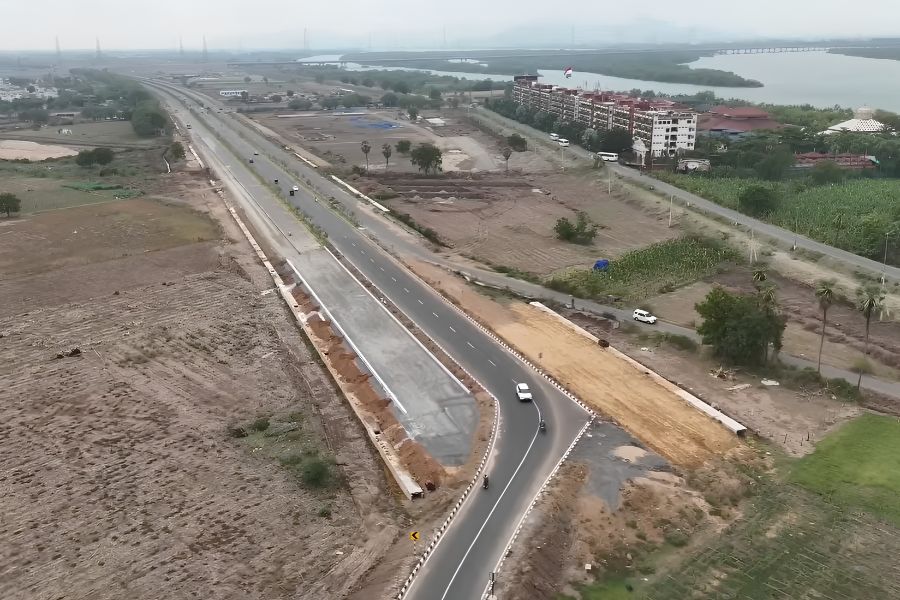
One of the biggest affected projects is the 21-km Seed Access Road (E3), one of Amaravati’s most important arterial roads connecting Vijayawada directly with the capital city.
Although most of the road has been planned and constructed, several portions remain disconnected because they pass through land that was never pooled.
Missing links include:
- Undavalli – 10.50 acres: The largest bottleneck. This missing stretch prevents the Seed Access Road from establishing its final connection with NH-16 and the Mangalagiri Road.
- Penumaka – 0.65 acres: A small but crucial gap interrupts the continuity of the arterial road.
- Mandadam – 0.70 acres: Another isolated missing link within the capital core.
- Rayapudi – 0.72 acres: Two small unpooled blocks continue to interrupt the western section of the corridor.
In total, just 12.57 acres of unpooled land have prevented seamless connectivity on one of Amaravati’s most critical roads.
Why is the government acquiring land now?
The APCRDA says the remaining 494 acres are required to complete roads, drainage systems, public utilities and other infrastructure planned under Phase-I, which the government wants to finish by 2028.
Officials argue that voluntary negotiations have not yielded results even after several years, leaving compulsory acquisition as the only option to remove critical infrastructure bottlenecks.
Why are farmers opposing land acquisition?
Farmers say the government is offering only one-time cash compensation, whereas land values in Penumaka and Undavalli are far higher than the official government rates.
Under the Right to Fair Compensation and Transparency in Land Acquisition, Rehabilitation and Resettlement Act, 2013, compensation is calculated using the government’s registered land value maintained by the local sub-registrar.
The government estimates agricultural land values at:
- Undavalli: ₹25 lakh to ₹35 lakh per acre
- Penumaka: ₹30 lakh to ₹40 lakh per acre
The law generally doubles these values for rural and semi-urban areas and adds a 100% solatium because the acquisition is compulsory.
Based on this formula, the estimated compensation works out to roughly ₹1 crore to ₹1.6 crore per acre, depending on the location.
Farmers argue that these official values are much lower than the actual market value of their land and do not reflect what the land could be worth after Amaravati is fully developed.
APCRDA maintains that farmers who joined the Land Pooling Scheme could eventually own developed plots worth ₹4 crore to ₹5 crore per acre after roads, underground power lines, water supply, drainage and other urban infrastructure are completed.
Farmers opposing acquisition, however, argue that compulsory acquisition deprives them of this long-term opportunity.